
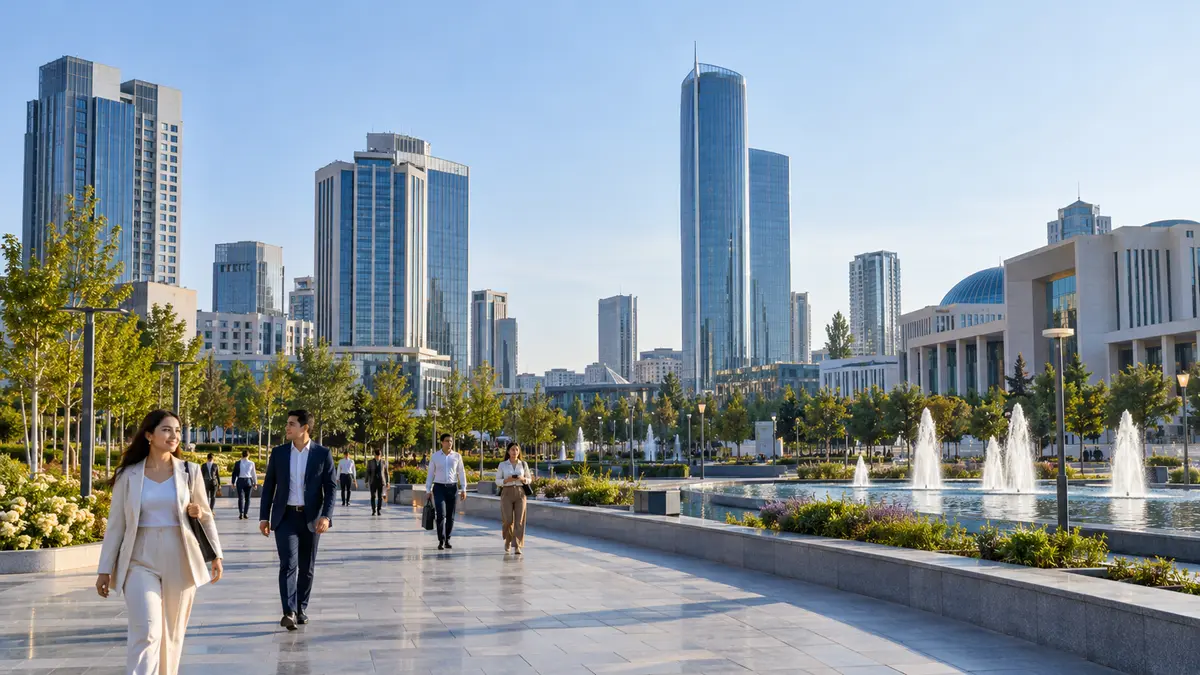
Uzbekistan is a country with a great future to build. Buyuk Kelajak expresses that aspiration in Uzbek: a future measured in the lives people can lead, the businesses they can establish and the opportunities available to the next generation. The phrase belongs here as an expression of ambition, rather than a promise that every announced project will succeed.
The practical foundations are already visible across different parts of the country: electricity networks, classrooms, irrigation systems, local enterprises and institutions serving a changing economy. Examining those foundations requires keeping completed improvements separate from approved finance and projected results. The distinction matters throughout this account of the country's prospects.
A stronger electricity network for a growing economy
Electricity distribution received a new financing commitment on 27 October 2026, when the World Bank approved a $100 million loan. The programme combines that contribution with $200 million from the Asian Development Bank and $71 million from the government, giving total financing of $371 million. Modernization and digitalization will cover 60 key substations nationwide.
The National Electric Grid of Uzbekistan will implement the programme. Its scope includes operational capacity, financial systems, cybersecurity, environmental and social standards, and gender equality in employment. The financing is an approved commitment; it is not a declaration that the substations have already been modernized.
By 2031, expected results include reducing annual losses at renovated substations by 20,000 megawatt-hours and enabling at least 3.3 gigawatts of renewable energy. These are programme expectations. The accompanying estimate of 11,700 additional or better jobs relates to the five years after commissioning, rather than jobs already created when the loan was approved.
Source: World Bank · 2026-10-27

Growth within a more difficult regional outlook
Uzbekistan entered the autumn of 2026 with an unusually strong growth projection in its wider region. The World Bank's October economic update forecast expansion of 7.9% for the country, compared with 5.8% for Central Asia and 2.2% for Europe and Central Asia overall. These figures describe the institution's outlook at that point, not final national accounts for the year.
The regional picture combined domestic support for activity with external pressures. Real wages, remittances, tourism and public investment helped sustain demand across the region. Higher energy costs and weaker activity in trading partners remained concerns, while some temporary relief measures added to fiscal pressure.
The same assessment identified risks from disrupted trade, more expensive transport and fertilizer, tighter financing and extreme weather. Those qualifications belong beside the positive forecast.
Source: World Bank · 2026-10-06

Renewable generation alongside storage
Uzbekistan's renewable-energy development includes projects designed to connect generation with storage. In May 2024, the World Bank Group, Masdar and the government signed a financing package for a 250-megawatt solar photovoltaic plant and a 63-megawatt battery energy storage system in Bukhara region. The planned electricity access benefit was approximately 75,000 households.
The storage component was intended to add flexibility to the power system and address the intermittent nature of renewable generation. The financing arrangement included an IFC loan of up to $53 million, alongside loans of up to $106 million from ADB, FMO and JICA. A World Bank guarantee of up to $12 million supported government payment obligations.
This is a dated financing record, not confirmation of the installation's operating status in October 2026. Its relevance lies in the combination of plant capacity, storage, financing and payment support. Each has a distinct place in the project structure, and none should be mistaken for electricity already delivered to consumers.
Source: World Bank · 2024-05-21
Competitive markets and the demand for jobs
Uzbekistan's growing adult population creates a substantial employment requirement. A February 2026 World Bank business-environment brief estimated that more than 400,000 jobs would be needed annually over the following decade. The barriers it identified included the footprint of state-owned enterprises, weak competition, constraints on firm growth and inefficient allocation of capital.
A C-JET grant supports work on the regulatory environment at national and local levels. The programme also includes advisory services intended to reduce state dominance and support fair competition. Its priorities cover several practical aspects of operating a business:
- Improving regulatory quality and simplifying business entry and operations.
- Increasing transparency and digitalization.
- Reducing compliance costs.
- Making the business environment more predictable.
These priorities concern the conditions under which firms start, compete and expand. The accompanying FINGROW initiative addresses access to finance, particularly for women and young people. Both strands remain reform programmes with intended effects; the employment requirement is not an announcement that every required job has already been provided.
Source: World Bank · 2026-02-24
Investment opportunities with specific conditions
Private investment opportunities extend beyond a general description of Uzbekistan as a growing market. The World Bank Group's July 2026 private-sector diagnostic examined logistics, tourism and pharmaceuticals, linking prospective investment to identifiable regulatory and institutional changes.
In logistics, the assessment associated improved conditions with potential private investment of up to $1.05 billion and 41,000 jobs. Its tourism scenario envisaged $3.1–$4.2 billion and up to 180,000 jobs, conditional on improvements in land tenure, skills and site management. For pharmaceuticals, streamlined registration and domestic bioequivalence laboratories were among the reforms associated with potential investment of up to $188 million and more than 20,000 skilled jobs.
These sector estimates are opportunities under reform scenarios, not money already invested or workers already hired. The diagnostic also identified a continuing state-enterprise presence exceeding 30% of GDP. Tax burdens, access to finance and skills gaps remained business concerns. The opportunity and the unfinished reform agenda therefore appear together in the same investment assessment.
Source: IFC / World Bank Group · 2026-07
Finance for smaller firms
Small-business finance has a defined programme of its own. In December 2025, the World Bank approved a $100 million loan and a $5 million grant for Uzbekistan's Access to Finance for Jobs and Growth Project, known as FINGROW. Its intended beneficiaries are capital-constrained micro, small and medium enterprises.
The financing gaps were substantial in the accompanying assessment. More than one-third of these businesses lacked bank accounts, while reported access to loans covered only 10% of small firms and 16% of medium-sized firms. Women-led businesses owned nearly one-third of registered enterprises in this category but received around 14% of its loans.
The Entrepreneurship Development Company, under the Ministry of Economy and Finance, is central to implementation. Dedicated subsidiaries are intended to work with banks, microfinance organizations and private-equity investors through guarantees and equity support. By 2030, the project expects around 7,000 firms to gain credit financing. That target describes a planned expansion in access, not a completed result or an unconditional entitlement to a loan.
Source: World Bank · 2025-12-15
Foundational learning for the next generation
Uzbekistan's future workforce is also the subject of a major primary-education programme. Approved in June 2026, BILIM has total financing of $378 million: $273 million from the government, $100 million in concessional IDA financing and a $5 million grant from the International Finance Facility for Education.
The programme covers Khorezm, Kashkadarya, Surkhandarya, Bukhara, Navoiy and the Republic of Karakalpakstan. Its objectives include improved teaching and management practices for 50,000 teachers, school leaders and administrators, alongside 27,000 additional school seats. Better education data and resource allocation are also part of the programme.
Access and learning are separate measures
Primary enrollment already exceeds 99%, but reading and mathematics outcomes remain weak by international standards. The planned benefits concern about two million children in Grades 1–4, half of them girls. School places, teacher development and measurable learning therefore have separate roles in the programme. The announced targets describe the work ahead toward 2030, rather than improvements already achieved by every participating school.
Source: World Bank · 2026-06-30
Mahallas and the reach of public infrastructure
Rural development extends the national picture beyond major urban investment. In June 2026, the World Bank approved $150 million in concessional financing for the second phase of Uzbekistan's Rural Infrastructure Development Program. The new phase has a $340 million budget, including $120 million from the Asian Infrastructure Investment Bank and $70 million from the government.
Implementation is planned in 296 mahallas across six regions. Financing is to be released against agreed results and milestones. Local residents participate in selecting and overseeing subprojects through Mahalla Development Units, whose composition includes at least 50% women.
The earlier phase offers a separate record of delivery. By its June 2026 completion, it had financed more than 900 subprojects in 306 mahallas. These included roads, electricity systems, water supplies, schools, preschools and bridges, benefiting around one million residents. The distinction between phases matters: the earlier programme's completed improvements should not be counted as achievements of its newly financed successor.
Source: World Bank · 2026-06-17
Enterprise beyond the capital
Rural entrepreneurs provide concrete examples of business development outside Tashkent. By February 2026, the Second Rural Enterprise Development Project had reached more than 15,000 entrepreneurs since its July 2022 launch. Its activities included 22 incubation hubs providing financial-literacy and entrepreneurial training, with particular attention to women and young people.
In Khanka District in Khorezm, Ulugbek Ibragimov used a loan through a participating bank to establish bottled-water production. Filtration equipment addressed the high salinity of local water. The enterprise employed ten local residents, including four women.
Another Khanka entrepreneur, Rasulbek Yusupov, restarted rope production with project-supported finance after disruption during the pandemic. He reported hiring six additional workers. The ropes serve local horticulture and livestock activities, and material scraps are recycled into products. These are individual beneficiary experiences within a wider programme. They describe identifiable operations and employment, without representing every rural firm's circumstances or establishing a national average return from borrowing.
Source: World Bank · 2026-02-05
Water security in the Ferghana Valley
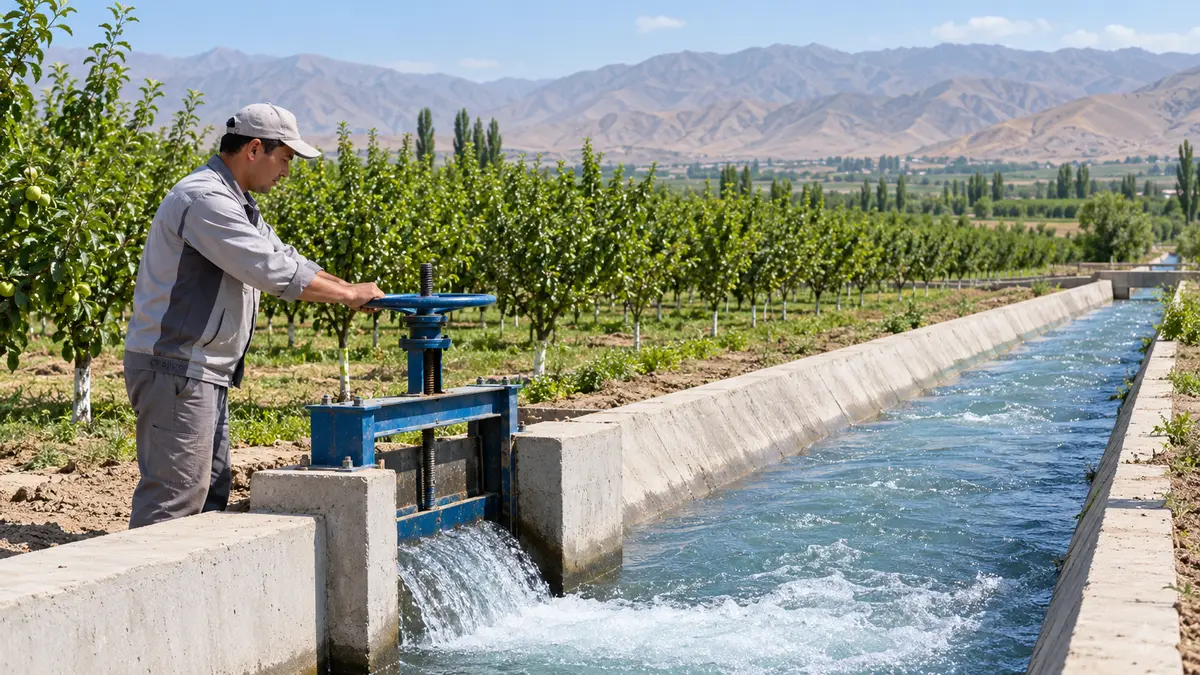
Reliable water is a practical part of rural opportunity. Improvements under the second phase of the Ferghana Valley Water Resources Management Project included rehabilitation of around 365 kilometres of canals and repairs to nearly 1,500 water-control structures. Improved irrigation and drainage served more than 100,000 hectares and almost 65,000 farmers.
The Avval-Logon pumping station, commissioned in 2025, supplies approximately 5,000 hectares across fourteen villages. The project also combined infrastructure with training in efficient water use and improved farming practices. Nearly 12,000 people participated in that training.
European Union support helped fit twelve irrigation wells with solar panels totaling almost 500 kilowatts. These systems pump more than four million cubic metres annually and provide clean drinking water to approximately 2,300 people. The valley's investments span water delivery, energy use and household services. Their scale is regional: these reported benefits should not be presented as if they describe the performance of all irrigation networks throughout Uzbekistan.
Source: World Bank · 2026-09-02
Women moving from informal work into enterprise
Women's entrepreneurship includes smaller, locally targeted interventions as well as national financing programmes. In May 2026, women from Karshi, Samarkand and Bukhara gathered in Tashkent for equipment-grant awards under an initiative involving UNDP, Uzbekistan's Ministry of Employment and Poverty Reduction and the Turkish Cooperation and Coordination Agency, TİKA.
More than 270 applications were submitted, and training brought together 69 women entrepreneurs. Nearly half of the participants formalized their businesses while seeking grants and support. A competitive selection subsequently awarded fourteen entrepreneurs equipment grants worth up to $5,000 each.
The programme addressed barriers associated with informal work, including restricted access to finance, social protection and business-development opportunities. Its outreach used Monocenters and public awareness activities. These figures describe this particular training and grant process, not all women-owned businesses in the country. They add a specific record of participation and business formalization to the wider picture of opportunity, while keeping a modest programme's reach distinct from the much larger national need.
Source: UNDP · 2026-05-22
A digital future that includes safety
Digital development is accompanied by work on the safety of young users. A joint UNODC–UNDP programme operated from February 2025 to July 2026 with support from the United Nations Trust Fund for Human Security. National partners included education and law-enforcement institutions, civil society and youth organizations.
The programme reached more than 100,000 people, including young people, teachers, community representatives and law-enforcement personnel. It established a pilot Youth Cybercrime Prevention Centre in Tashkent and a virtual Resource and Methodological Centre. An e-learning platform offered six interactive modules covering 29 topics and seven video lessons.
More than 150 professionals received specialized training. Educational materials were adapted into Uzbek and Russian, while young participants contributed to public-awareness activities. These are documented programme outputs, not evidence that online threats have disappeared. A future with more digital services also includes the institutions, learning resources and practical skills required to respond to cybercrime and digital violence, particularly where young people encounter new forms of risk.
Source: UNDP · 2026-07-31
A future shaped by climate and resource choices
Uzbekistan's long-term development also faces physical limits and environmental pressures. The World Bank's Country Climate and Development Report examines growth alongside adaptation and a pathway toward carbon neutrality by 2060. Its assessment identifies water scarcity, drought, extreme heat, rainfall volatility and the effects of the Aral Sea ecological disaster among the country's risks.
Energy accounts for about 75% of greenhouse-gas emissions in that assessment. Proposed responses include efficiency, renewable energy, better water management, climate-smart agriculture and strengthened social protection. The report models an economy around 10% smaller by 2050 without adaptation, compared with the relevant counterfactual. That is a conditional scenario, not a certain prediction of national output.
Buyuk Kelajak can encompass both ambition and this unfinished work. The documented programme of change includes investment, institutional reform and local participation; its future results remain to be delivered and measured. Uzbekistan's great future is an aspiration grounded in specific opportunities, with room for confidence and an equally clear record of what still lies ahead.
Source: World Bank · 2023




Your perspective
Share your thoughts on the story.